Ronia’s estrangement from Matt
Ronja, the Robber's DaughterRonia’s estrangement from Matt is the painful rupture between a daughter who rejects her father’s robber’s life and a father who cannot at first separate love for her from his claim to inherit that life. It is not simply a quarrel over whether Ronia will become a robber chief: it grows into a refusal to recognize one another, then ends when Matt finally asks her to come home and makes room for Birk as well.
Origins in a moral disagreement
The breach begins with Ronia’s discovery of where the robbers’ possessions come from. Seeing the goods they carry home in sacks, bundles, chests, and boxes, she understands that the things do not grow in the forest: Matt’s band has taken them from other people. She asks whether their victims become terribly angry. Noddle-Pete answers that they howl, cry, and swear, treating their distress as entertainment. His amusement makes the human cost plain to Ronia, while Matt’s attempts to quiet him cannot undo what she has heard.
Matt presents robbery as a family inheritance and a source of pride. He tells Ronia that his father and grandfather were robber chiefs, that he has lived up to them, and that she will become one too. Ronia rejects the succession outright. Her refusal is not a wish to take over the same role by gentler means: the victims’ anger and tears are precisely what make the robber’s calling unacceptable to her. Matt, who wants her to admire and love him as he loves and admires her, is distressed by the refusal and tries to justify his conduct by saying that he takes only from the rich. That defense does not resolve their conflict; it shows how deeply his affection is entangled with the expectation that she will approve of his life.
The rupture over Birk
The disagreement becomes a direct break when Matt detains Birk and claims the right to define whether Ronia can still be his daughter. Ronia tells him that he can rob goods and money, but not people: if he does, she will no longer be his daughter. Matt replies by calling Birk a snake fry, a louse, and a thieving hound, and insists that he will clear his father’s fortress of him. His language reduces Birk to an intruder and turns the family bond into something Matt can threaten to withdraw. Ronia’s outcry, calling him a beast, makes clear how far the old intimacy has given way to moral anger.
Later, at Bear’s Cave, the conflict is no longer only about robbery. Ronia has returned with her mother, Lovis, after swimming with Birk, but Birk refuses to greet Lovis, whom he regards as an uninvited guest. His coldness wounds Ronia; in her fury and desperation she feels pulled apart by Birk, Lovis, Matt, the cave, the forest, and the changing seasons. The quarrel with Birk exposes the cost of the estrangement from Matt: Ronia has tried to hold on to her brother while remaining bound to her parents, and now she experiences those attachments as competing claims.
Silence in the winter forest
Ronia tells Lovis that she will never come home. When Lovis answers that Matt might jump in the river if she stayed away, Ronia asks whether he would do that for her, since he will not even mention her name. Lovis explains that Matt has had to send Noddle-Pete away because the old man could no longer bear being with him; Matt, she says, still needs someone to hold on to when things become unbearable. Her account suggests that Matt’s grief is real, but grief alone has not crossed the distance between them.
Ronia puts the condition for a return into words. If a child’s father denied her so completely that he would not even say her name, she asks Lovis, should the child go back without being asked? Lovis says that the father would have to ask. Ronia answers that Matt never will. This conviction sustains the estrangement even while she remains deeply affected by Matt’s silence: she hides her face against Lovis’s knee and cries. The break is therefore not a clean severance of love. It is a painful standoff in which Ronia will not return on the strength of her own longing alone; she needs Matt to acknowledge that she is still his child and to invite her back.
The spring reunion
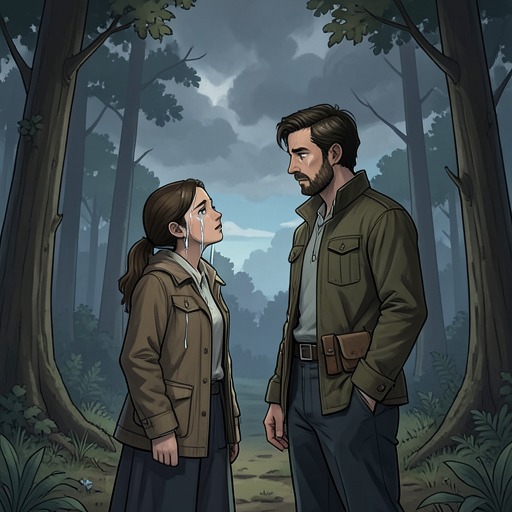
That invitation comes in the woods. Ronia walks along the narrow mountain path to fetch water from the spring, where she finds Matt sitting alone on a stone. At the sight of his familiar dark, curly head, she begins to cry. Matt is crying too. When he notices her, he flings an arm across his eyes to hide his tears; the helplessness of the gesture moves Ronia to rush into his arms. Matt calls her his child, then exclaims that he has her back. Ronia asks whether she is really his child again, giving voice to the insecurity created by his earlier rejection. Matt assures her that she has always been his child and tells her how much he has suffered.
Matt then asks whether Lovis was right that Ronia would come home only if he asked her. As he and Ronia prepare to leave, he makes the request plainly, with all his heart. The scene reverses the earlier silence: the father who would not say his daughter’s name now addresses her directly and asks her home. Yet the reconciliation does not require Ronia to abandon Birk. She knows she cannot leave him to freeze alone in the winter forest and thinks of him as her brother, bound to her for life and death.
Making room for both bonds
Matt’s decisive change is to turn his invitation beyond Ronia. After noticing Birk, he calls him over, admits that he would rather beat him, then asks him to return to Matt’s Fort with them. Matt does not pretend to like Birk; instead, he acknowledges that Ronia does and says that perhaps he can learn to do so too. He has had months to think. By addressing Birk rather than demanding that Ronia choose between them, Matt releases the choice that has kept her divided between father and brother.
Ronia feels the change physically as the lump of ice she has carried inside her melts like a spring brook. The image gives the reconciliation a seasonal shape: the estrangement had made love feel frozen and immovable, but Matt’s words let it flow again. Her gladness and gratitude are mixed with apprehension because Birk looks confused and suspicious; reconciliation with Matt cannot simply dictate what Birk will choose. The episode nevertheless resolves the central father-daughter breach on different terms from those on which it began. Matt first expected Ronia to inherit his robber chief’s life; now he asks her home while accepting the importance of the person she has chosen as family.
The continuing moral difference
The reunion repairs the relationship without erasing the disagreement that caused its rupture. Ronia still believes that the cleverest course is to stop robbing, a view she states when Noddle-Pete proposes a single combat to bring Borka into line and unite the robber band. Noddle-Pete agrees that she is right, though he says he is too old and feeble to drum the idea into Matt. The exchange confirms that Ronia’s refusal is more than a temporary rebellion against her father: she continues to challenge the robber life itself.
Matt’s reconciliation with Ronia therefore matters because he can make room for her attachments without first winning her over to his values. Their estrangement ends not with her acceptance of his inherited calling, but with his recognition that she remains his child and his willingness to invite Birk too. Affection survives the moral conflict, but it no longer depends on Ronia becoming the robber chief Matt had imagined.